The 1500 Illusion: Why High Scores Don’t Equal Readiness
It’s CTE Month, and I’m going to lean into something I’ve believed for a long time.
Grades are not an indicator of readiness.
Standardized test scores can actually work against the very students we celebrate most.
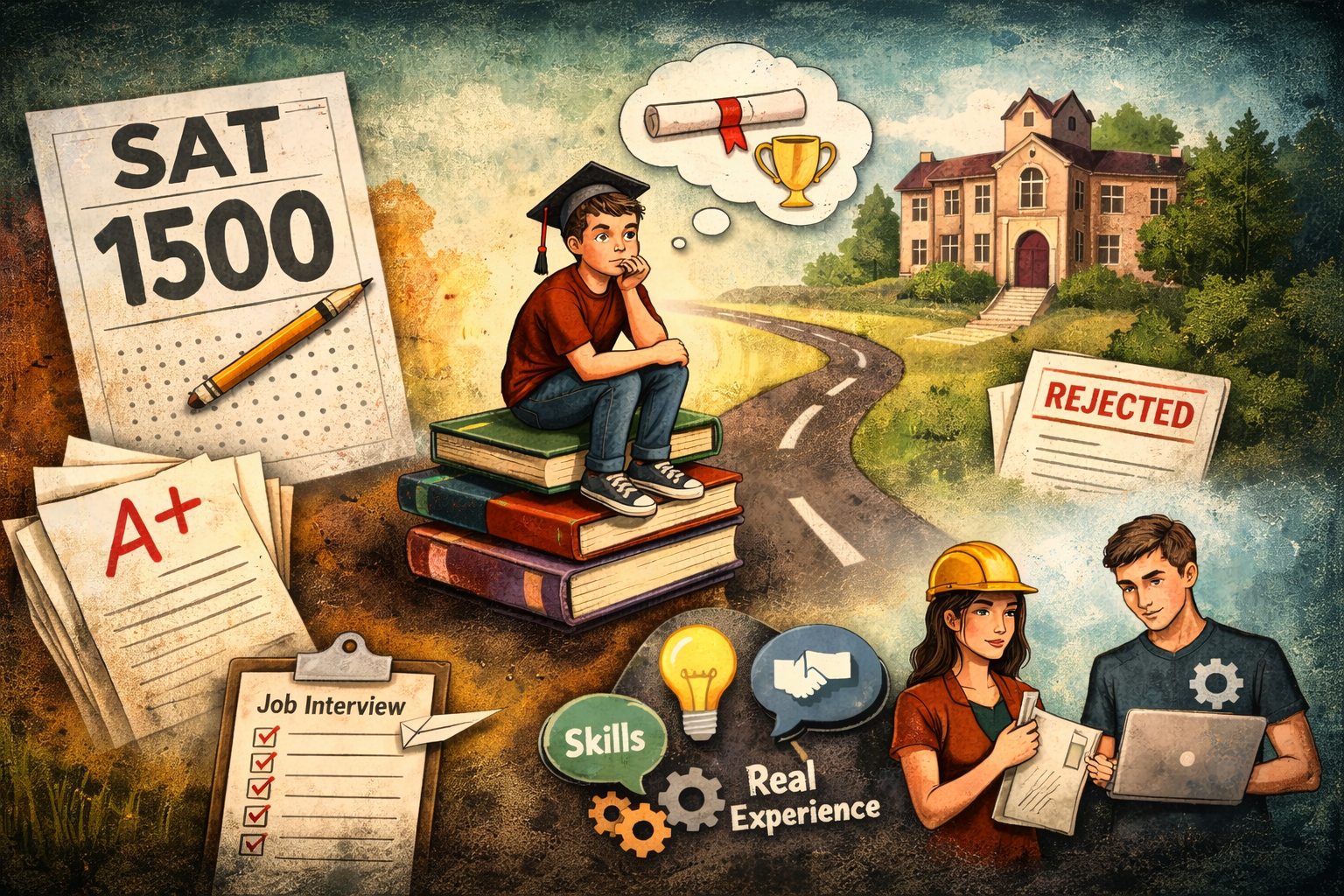
After nearly a quarter century in education, I’ve seen the same pattern repeat itself. A student earns a 1500 or higher on the SAT. They are labeled exceptional. Adults reinforce the narrative. Doors are “supposed” to open. The message is clear: you’ve mastered the system.
And then something subtle happens.
Curiosity slows down.
Risk-taking decreases.
Growth flattens.
Some of the highest superscore students I’ve worked with begin to believe they are done learning. Not because they are arrogant. But because the system quietly told them they’ve already won. When your identity becomes “high performer,” you become very careful not to damage that identity. You protect it. You stay inside the lanes where you know you’ll succeed.
But readiness lives outside those lanes.
I’ve watched superscore students not get into their top-choice colleges. I’ve watched them struggle in interviews because they’ve never had to explain their thinking beyond a written response. I’ve watched them freeze when asked about failure, teamwork conflict, or a time they had to pivot. They had transcripts. They had numbers. But they didn’t have stories.
They didn’t know how to communicate their value beyond being good at school.
And the world is changing.
Colleges are rethinking the weight of test scores. Employers are demanding demonstrable skills. Artificial intelligence is reshaping what knowledge work looks like. The ability to memorize and reproduce information is no longer the differentiator. The differentiator is adaptability, communication, collaboration, and problem-solving in ambiguous situations.
Standardized tests don’t measure that. In some cases, they discourage it.
When we over-celebrate performance metrics, we unintentionally build a ceiling. Students optimize for the grade. They chase the score. They play the game well. But they don’t always build the professional self that can thrive beyond it.
This is why CTE Month matters.
Career and Technical Education is not about diverting students from college. It is about building readiness for college, for career, for contribution. It shifts the focus from performance to application.
In my work, students don’t get handed internships. They interview. They research organizations. They ask questions. They experience rejection. They refine their approach. That process alone builds more real-world readiness than another standardized prep cycle.
When students step into authentic work-based learning experiences, everything changes. They sit in meetings with adults. They deliver projects that matter to organizations. They receive feedback that isn’t tied to a rubric but to impact. They see that communication, reliability, and initiative matter just as much as accuracy.
I’ve seen students with average GPAs outperform top-ranked classmates in professional settings because they can listen well, ask better questions, and build trust. I’ve seen students grow exponentially when they understand their natural aptitudes and are intentionally exposed to pathways they didn’t even know existed. Interests fluctuate. Aptitudes are more stable. When students combine self-awareness with exposure, their decisions become informed rather than assumed.
And perhaps most importantly, students must learn how to find and show their value.
A transcript says what you earned.
A portfolio shows what you can do.
When students build digital portfolios, document their projects, reflect on feedback, and articulate growth, they begin to own their professional identity. They move from “I got an A” to “Here’s the problem I solved, here’s what I learned, and here’s how I improved.” That shift is powerful.
Reflection is the multiplier. After interviews. After internships. After setbacks. Without reflection, even great experiences become checkboxes. With reflection, experience becomes transformation.
This is not an argument against college. College can be an incredible pathway. But readiness for college and readiness for life are not measured by a single Saturday morning exam score.
The future does not belong to the best test takers. It belongs to the most adaptable, curious, collaborative problem solvers in the room.
If we truly care about student success, we have to expand the scoreboard. We have to reward growth, communication, initiative, and contribution. We have to create systems where students are pushed to stretch beyond the metric that once defined them.
It’s CTE Month.
Let’s celebrate the programs that connect students to real adults doing real work. Let’s elevate durable skills as the currency of the AI era. Let’s help students build professional identities rooted in value, not just validation.
Because a 1500 might open a door.
But curiosity, adaptability, and the ability to communicate your value — > that’s what keeps it open.

Peter Hostrawser
Creator of Disrupt Education
My value is to help you show your value. #Blogger | #KeynoteSpeaker | #Teacher | #Designthinker | #disrupteducation